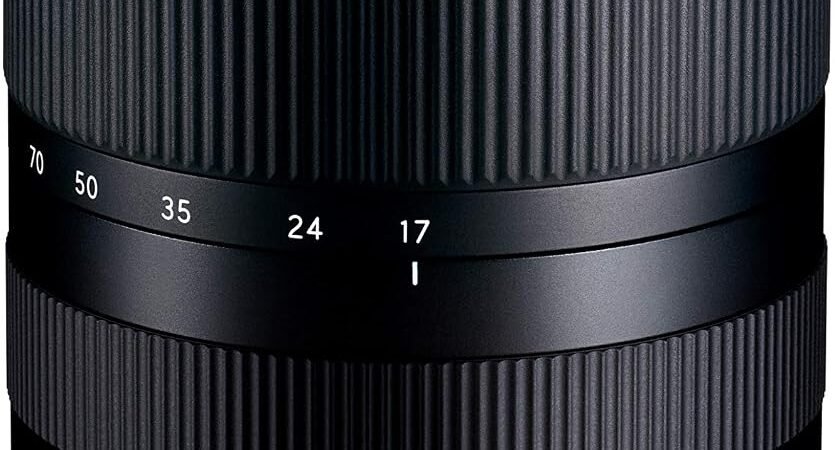
A versatile zoom lens can simplify photography by allowing one lens to cover several useful perspectives. Instead of changing lenses whenever a subject moves farther away or a scene becomes wider, a zoom can provide flexibility while keeping the camera ready to shoot.
The Tamron 17-70mm f/2.8 Di III-A VC RXD is designed specifically for APS-C mirrorless cameras using the Sony E-mount. It combines a 17–70mm focal-length range with a constant f/2.8 maximum aperture, built-in Vibration Compensation, and an RXD autofocus system. Tamron identifies the lens as Model B070 and lists its Sony E-mount version at 525 grams, with a 119.3mm length and 67mm filter diameter.
On a Sony APS-C camera, the 17–70mm range provides a full-frame-equivalent field of view of approximately 25.5–105mm. That gives the lens a useful progression from moderately wide-angle framing through normal perspectives and into short telephoto territory.
The lens is therefore relevant to a broad range of photography, including travel, portraits, street photography, family photography, landscapes, everyday shooting, and video.
However, understanding the lens properly requires looking beyond the focal-length range. Its constant aperture, stabilization system, autofocus motor, close-focusing ability, optical construction, physical dimensions, and compatibility with Sony APS-C cameras all influence how it fits into a camera kit.
This guide examines those characteristics in detail without treating the lens as a universal solution for every photographer.
Introduction to the Tamron 17-70mm f/2.8 Di III-A VC RXD
The Tamron 17-70mm f/2.8 Di III-A VC RXD was introduced as a high-speed standard zoom for Sony E-mount APS-C mirrorless cameras. Tamron announced the Sony E-mount version in December 2020, with a January 14, 2021 launch date.
Its design is centered around four major characteristics:
- A 17–70mm zoom range
- A constant f/2.8 maximum aperture
- Built-in VC image stabilization
- RXD autofocus
The combination is significant because APS-C cameras are often chosen for their relatively compact size compared with full-frame systems. A lens with a broad focal range can complement that approach by reducing the need to carry several lenses.
At 17mm, the lens provides a moderately wide perspective suitable for many environmental scenes. At 70mm, the field of view becomes substantially tighter and reaches the short-telephoto range on an APS-C sensor.
The constant f/2.8 aperture remains available throughout that range. This is useful when moving between focal lengths because the maximum aperture does not change as the lens is zoomed.
Tamron also incorporates its VC system for reducing the effects of camera shake and its RXD stepping motor for autofocus. The company specifically describes the autofocus system as fast and quiet and highlights its suitability for both still photography and video.
Key Features
17–70mm Focal-Length Range
The most obvious feature is the 17–70mm focal-length range.
On Sony APS-C cameras, Tamron gives the corresponding full-frame-equivalent field of view as approximately 25.5–105mm.
That range can be divided into several practical sections.
At 17mm, the lens can capture broader scenes. This can be useful for:
- Travel photography
- Landscapes
- Architecture
- Street scenes
- Group photographs
- Environmental portraits
- Indoor photography
Moving toward 35mm produces a more moderate perspective suitable for everyday subjects.
At approximately 50mm, the lens can be used for general-purpose compositions, portraits, food, street photography, and documentary-style images.
At 70mm, the lens reaches a short-telephoto perspective on APS-C. This can help with portraits, details, and subjects that are somewhat farther away.
The flexibility of this range is one of the defining characteristics of the lens.
Constant f/2.8 Aperture
The lens maintains a maximum aperture of f/2.8 across its entire 17–70mm range.
A constant aperture is useful for several reasons.
First, the maximum aperture does not become smaller as the lens is zoomed toward 70mm. This gives photographers consistent control over exposure when changing focal length.
Second, f/2.8 allows more light to reach the sensor than many slower zoom lenses.
This can be useful for:
- Indoor photography
- Evening scenes
- Events
- Travel after sunset
- Available-light photography
- Portraits with background separation
A wide aperture also provides greater control over depth of field. At 70mm and relatively short subject distances, f/2.8 can help separate a subject from the background.
The actual appearance of background blur depends on subject distance, background distance, focal length, aperture, and the camera’s sensor format.
Vibration Compensation
The lens incorporates Tamron’s VC, or Vibration Compensation, system.
Tamron explains that VC is designed to reduce image degradation caused by camera shake during handheld shooting, particularly at slower shutter speeds. The company also describes stabilization functionality for video.
This can be useful when photographing relatively stationary subjects in situations where a faster shutter speed is not necessary.
For example, an indoor still-life scene can potentially benefit from stabilization because the photographer can maintain a slower shutter speed while reducing the effect of camera movement.
It is important to understand that stabilization does not freeze subject movement. If a person, animal, vehicle, or other subject is moving quickly, subject motion can still produce blur.
The interaction between the lens’s VC and a particular Sony camera body can also depend on whether the camera has its own stabilization system.
RXD Autofocus
The lens uses Tamron’s RXD, or Rapid eXtra-silent stepping Drive, autofocus technology.
Tamron describes the system as using a stepping motor to drive the focusing lens directly and says it is designed for high-speed, accurate, and quiet autofocus.
This makes the lens relevant to both photography and video.
For still photography, autofocus can help when working with moving subjects or changing compositions.
For video, reduced operating noise is particularly useful because mechanical or focusing sounds can potentially be picked up by an onboard or nearby microphone.
Tamron also states that the lens is designed with suppressed focus breathing, meaning the apparent change in angle of view during focus changes is reduced.
Optical Construction
The lens contains 16 elements in 12 groups. Tamron’s optical design includes two Low Dispersion elements, two Glass Molded Aspherical elements, and one hybrid aspherical element.
These components are intended to address different optical challenges.
Low Dispersion elements are used to help control chromatic aberration, which can otherwise appear as color fringing around high-contrast edges.
Aspherical elements can help control various optical aberrations and contribute to maintaining image quality toward the edges of the frame.
Tamron also uses BBAR, or Broad-Band Anti-Reflection, coating to help minimize unwanted ghosting and flare.
As always, actual image quality depends on the complete photographic system, including the camera sensor, aperture, focal length, lighting, focusing accuracy, and post-processing.
Close-Focusing Capability
The lens offers relatively close focusing for a standard zoom.
Tamron lists a minimum object distance of 0.19 meters at 17mm and 0.39 meters at 70mm. Maximum magnification is approximately 1:4.8 at the wide end and 1:5.2 at the telephoto end.
This can make the lens useful for photographing:
- Food
- Small products
- Flowers
- Tabletop scenes
- Crafts
- Travel details
- Everyday objects
The close-focusing capability does not make the lens a dedicated macro lens. Dedicated macro lenses are designed around substantially greater magnification and specialized close-working characteristics.
Nine-Blade Circular Aperture
The diaphragm uses nine aperture blades and is designed to remain nearly circular when stopped down by up to two stops from maximum aperture, according to Tamron.
A circular aperture can contribute to smoother-looking out-of-focus areas and highlights.
The final appearance of bokeh is still influenced by the subject, background, focal length, aperture, and focusing distance.
67mm Filter Diameter
The lens uses a 67mm filter size.
This is useful information for photographers who already own filters or plan to use neutral-density, polarizing, or protective filters.
Using a common filter diameter across several lenses can simplify accessory management.
Compact APS-C-Oriented Design
For the Sony E-mount version, Tamron lists the lens at approximately 119.3mm long, 74.6mm in maximum diameter, and 525 grams in weight.
Those dimensions should be considered together with the camera body.
On a compact APS-C body, the lens is still a substantial component of the overall setup, but its size is designed around the APS-C format rather than being a much larger full-frame zoom.
Moisture-Resistant Construction
Tamron describes the lens as having moisture-resistant construction with sealing intended to provide additional protection when shooting outdoors. The company also incorporates a fluorine coating designed to repel water and oil from the optical surface.
Weather resistance should not be interpreted as complete waterproofing.
Outdoor photographers should still use reasonable precautions during heavy rain, around water, in dusty environments, and when moving between large temperature differences.
How the Tamron 17-70mm Can Be Used
Travel Photography
Travel is one of the natural applications for a lens with this focal-length range.
A photographer may encounter a wide street, a building, a portrait opportunity, a meal, a distant architectural detail, and a landscape within a single day.
The 17–70mm range allows many of these subjects to be photographed without switching lenses.
At 17mm, travelers can capture broader environments. At 70mm, they can isolate details that are farther away.
The 525-gram weight also makes the lens relatively practical for carrying throughout a day, although the overall weight of the camera and lens combination remains important.
Street Photography
Street photography often involves constantly changing distances.
A photographer may want a wider environmental composition one moment and a tighter framing the next.
The 17–70mm range provides that flexibility.
The autofocus system can also be useful when working with people and moving subjects.
At the same time, photographers should consider that the lens is larger than many compact APS-C prime lenses, so the physical size of the setup may influence how discreetly someone prefers to work.
Portrait Photography
The 70mm end provides a useful short-telephoto perspective on APS-C.
That can be suitable for portraits where the photographer wants tighter framing without moving extremely close to the subject.
The f/2.8 aperture can also help create background separation.
Portrait photographers can use the wider portion of the range for environmental portraits, where the surroundings are intentionally included.
This makes the lens capable of supporting more than one portrait style.
Family Photography
Family photography often involves unpredictable movement and changing distances.
Children may move from across a room to nearby within seconds, making a flexible zoom useful.
The 17mm end can help with group scenes, while 70mm provides more reach for individual subjects.
Autofocus can assist when the subject’s position changes, although actual tracking behavior depends on the connected Sony camera and its autofocus system.
Landscape Photography
The 17mm end offers a moderately wide field of view on Sony APS-C.
This can be useful for:
- Mountains
- Beaches
- Forests
- Urban landscapes
- Large outdoor scenes
- Environmental compositions
It is not an ultra-wide lens, so photographers who specifically want extremely expansive perspectives may still require a dedicated ultra-wide lens.
However, the ability to zoom toward 70mm can be useful for isolating distant landscape details.
Food and Tabletop Photography
The close-focusing capability can be useful for photographing food and tabletop subjects.
At 17mm, the lens can provide a relatively broad environmental view of a table or kitchen.
At longer focal lengths, photographers can isolate details such as individual dishes, ingredients, or objects.
The 0.19-meter minimum object distance at the wide end provides additional flexibility for close compositions.
Events
Events often require photographers to switch between group compositions and individual subjects quickly.
The 17–70mm range can accommodate both.
The constant f/2.8 aperture is also relevant in indoor environments where available light may be limited.
VC can help with camera shake when photographing relatively stationary moments, while autofocus can help with moving subjects.
As always, subject movement may require a faster shutter speed regardless of stabilization.
Video
The lens was designed with video applications in mind.
Tamron highlights the RXD autofocus system’s quiet operation, suppressed focus breathing, and VC stabilization.
This combination can be useful for:
- Travel videos
- Interviews
- Family videos
- Documentary content
- Handheld footage
- Walk-and-talk videos
- General creator work
The wide end can accommodate environmental scenes, while the telephoto end can provide tighter framing.
For professional video, creators should still consider camera stabilization, audio equipment, focus control, lens balance, and whether the 17–70mm range fits the production style.
Who This Lens May Be Suitable For
Sony APS-C Photographers
The lens is specifically designed for Sony E-mount APS-C mirrorless cameras.
Photographers using compatible Sony APS-C bodies can take advantage of the intended field of view and system integration.
Before purchasing, users should verify their exact camera model and firmware compatibility.
Travel Photographers
Travelers who want a single lens capable of covering moderately wide through short-telephoto perspectives may find the range useful.
It can reduce the need to carry several lenses for ordinary travel situations.
Hybrid Photo and Video Creators
The combination of f/2.8, VC, RXD autofocus, and suppressed focus breathing makes the lens relevant to people who produce both photographs and video.
Family and Everyday Photographers
For everyday subjects, a 17–70mm range can be more flexible than a single fixed focal length.
The lens can move from group scenes to individual subjects without requiring a lens change.
Portrait Photographers Who Also Need Environmental Coverage
A dedicated portrait prime can provide a different rendering and potentially a wider aperture, but the Tamron zoom can cover both environmental and tighter portrait compositions.
That flexibility may be useful for photographers who do not want a portrait-only lens.
Important Things to Consider
It Is an APS-C Lens
The most important compatibility consideration is the sensor format.
Tamron identifies the lens as a Di III-A lens for APS-C mirrorless cameras.
This means users should not treat it like a conventional full-frame lens.
On Sony APS-C cameras, the 17–70mm focal range corresponds to approximately 25.5–105mm in full-frame-equivalent field of view.
The 17mm End Is Wide, But Not Ultra-Wide
A 17mm APS-C setting provides a useful wide perspective, but it does not reach the extremely broad coverage of dedicated ultra-wide lenses.
Photographers specializing in architecture, tight interiors, dramatic landscapes, or very close environmental compositions may eventually want something wider.
The 70mm End Is Short Telephoto
The 70mm setting is useful for portraits and details, but it is not a long telephoto focal length.
Wildlife, bird photography, field sports, and distant subjects generally require substantially longer lenses.
f/2.8 Does Not Eliminate High-ISO or Fast-Shutter Requirements
A constant f/2.8 aperture allows more light than many slower zoom lenses, but photographers may still need to increase ISO or adjust shutter speed in very dark conditions.
If a subject is moving quickly, a fast shutter speed may be necessary even when the lens has a wide aperture.
Stabilization Does Not Freeze Motion
VC is designed to compensate for camera shake.
It cannot prevent motion blur caused by a moving subject.
This distinction is especially important for family photography, events, sports, and street photography.
Weight and Balance
At 525 grams, the lens is not a tiny pancake-style optic.
Photographers should consider the total weight of the camera and lens, particularly for long walks, hiking, or extended handheld sessions.
Filter Costs
The 67mm filter diameter is convenient if other lenses in the kit use the same size.
If not, photographers should factor in the additional accessories required for polarizers, ND filters, or other front-mounted equipment.
Weather Resistance Is Not Waterproofing
The moisture-resistant construction adds a degree of protection, but it does not mean the lens can be safely submerged or exposed indefinitely to heavy rain.
Outdoor equipment should always be handled according to the manufacturer’s guidance.
Comparing General Lens Categories
Standard Zoom vs. Prime Lens
A prime lens provides one fixed focal length.
The advantage is specialization. A photographer can choose a prime specifically for a certain perspective, aperture, size, or creative style.
The 17–70mm zoom instead emphasizes flexibility.
It can cover several perspectives without requiring the photographer to change lenses.
A prime may also be smaller or lighter depending on its design, while the zoom offers considerably more framing flexibility.
Standard Zoom vs. Kit Zoom
Many APS-C kit zooms use variable maximum apertures.
The Tamron maintains f/2.8 across the entire range.
That can provide greater consistency when changing focal lengths.
A slower kit zoom may still have advantages in portability and simplicity, depending on the particular model.
Standard Zoom vs. Ultra-Wide Zoom
An ultra-wide zoom generally begins at a much shorter equivalent focal length.
The Tamron 17–70mm is instead intended as a general-purpose standard zoom.
The two categories can complement each other: an ultra-wide zoom can handle very broad scenes, while the 17–70mm can cover everyday perspectives and short telephoto framing.
Standard Zoom vs. Telephoto Zoom
A telephoto zoom extends considerably beyond 70mm.
It is more appropriate for distant subjects, wildlife, sports, and other applications where reach is important.
The 17–70mm prioritizes a more general-purpose range.
Standard Zoom vs. Macro Lens
The Tamron can focus relatively close, particularly at 17mm, but it is not a dedicated macro lens.
A macro lens is designed for high magnification and close-subject work.
The Tamron’s close-focus capability is better understood as an additional feature that expands the usefulness of a standard zoom.
Understanding the 25.5–105mm Equivalent Range
The 17–70mm numbers describe the actual physical focal length.
Because the lens is designed for APS-C, the field of view differs from what the same focal length would produce on a full-frame camera.
Tamron lists the Sony APS-C equivalent range as approximately 25.5–105mm.
This means the lens starts around the traditional moderate-wide perspective and ends in short-telephoto territory.
The equivalent range is useful when comparing the lens conceptually with full-frame systems.
It should not be interpreted as changing the physical focal length of the lens. The lens remains a 17–70mm optic.
Close-Up Photography With the 17–70mm
Close focusing is one of the useful secondary characteristics of the lens.
At 17mm, the minimum object distance is approximately 0.19 meters. At 70mm, it increases to approximately 0.39 meters.
This can make the lens useful for close details without requiring a dedicated macro lens.
For example, a photographer traveling through a market could photograph an entire stall at the wide end and then move closer to capture individual objects.
Similarly, food photographers can move between wider table scenes and tighter details without changing lenses.
The lens therefore provides a practical bridge between general photography and close-up work.
The Role of Optical Coatings
Lens coatings are easy to overlook because they are not immediately visible in a specification list.
Tamron uses BBAR coating on this model to help reduce unwanted flare and ghosting.
These effects can become more noticeable when a strong light source is within or near the frame.
Good composition and appropriate use of the supplied hood can still be important when working in bright or backlit conditions.
Optical coatings do not guarantee that flare will never occur. Strong light sources, shooting angle, lens condition, and exposure all influence the final result.
Using the Lens for Video
The lens has several characteristics that make it relevant to video creators.
The RXD autofocus system is designed for quiet operation, while Tamron also emphasizes suppressed focus breathing.
Focus breathing refers to an apparent change in framing that can occur as the lens shifts focus.
Reducing this effect can make focus transitions look more natural.
The built-in VC system also provides stabilization support for handheld video.
However, video creators should remember that stabilization performance varies according to camera body, shooting movement, focal length, and stabilization settings.
A gimbal or other stabilization system may still be useful for particular production styles.
Maintenance and Care
Proper lens care can help preserve the optical and mechanical condition of the lens.
Simple practices include keeping the front and rear caps attached when the lens is not in use, storing it in a suitable environment, and using proper lens-cleaning materials.
The fluorine coating can make it easier to remove certain contaminants from the front optical surface, but it should not be treated as a substitute for careful handling.
Photographers working outdoors should also be cautious when moving between cold and warm environments because condensation can form on optical equipment.
If the lens becomes significantly wet or contaminated, users should follow appropriate manufacturer care guidance rather than applying household cleaning products.
Frequently Asked Questions
What cameras is the Tamron 17-70mm f/2.8 designed for?
The Sony version is designed for Sony E-mount APS-C mirrorless cameras. Tamron identifies this version as Model B070.
What is the full-frame equivalent focal range?
On Sony APS-C cameras, Tamron lists the equivalent field of view as approximately 25.5–105mm.
Does the aperture remain f/2.8 throughout the zoom range?
Yes. The lens has a constant maximum aperture of f/2.8 from 17mm through 70mm.
Does the lens have image stabilization?
Yes. It includes Tamron’s VC, or Vibration Compensation, system.
Does VC prevent subject motion blur?
No. VC is primarily intended to compensate for camera shake. Movement of the subject can still create blur.
What autofocus technology does the lens use?
It uses Tamron’s RXD, or Rapid eXtra-silent stepping Drive, autofocus system.
Is it suitable for video?
Yes. Tamron specifically highlights the lens’s quiet RXD autofocus, VC stabilization, and suppressed focus breathing for video applications.
How close can it focus?
The minimum object distance is approximately 0.19 meters at 17mm and 0.39 meters at 70mm.
Is it a macro lens?
No. It provides useful close-focusing capability, but it is a general-purpose zoom rather than a dedicated macro lens.
How much does the Sony E-mount version weigh?
Tamron lists the Sony E-mount version at approximately 525 grams.
What filter size does it use?
The lens uses a 67mm filter diameter.
Is the lens weather resistant?
Tamron describes it as having moisture-resistant construction and a fluorine coating for additional protection.
This should not be interpreted as complete waterproofing.
Can it be used for portraits?
Yes. The 50–70mm portion of the range can be useful for portraits, while the wider end can accommodate environmental portraits.
Is 17mm wide enough for landscapes?
For many landscapes, yes. However, it is not an ultra-wide focal length on APS-C, so photographers who frequently need very expansive coverage may prefer a dedicated ultra-wide lens.
Can the lens be used for travel?
The focal range is suitable for many travel situations, from moderately wide environmental scenes to tighter details and portraits. Its approximately 525-gram weight is also relevant when considering the overall travel setup.
Conclusion
The Tamron 17-70mm f/2.8 Di III-A VC RXD for Sony E APS-C mirrorless cameras is built around versatility.
Its 17–70mm focal range covers approximately 25.5–105mm in full-frame-equivalent field of view, giving Sony APS-C photographers access to moderately wide, normal, and short-telephoto perspectives in a single lens.
The constant f/2.8 aperture provides consistent maximum-aperture capability throughout the zoom range, while Tamron’s VC system is designed to reduce the effects of camera shake. The RXD autofocus system adds fast and quiet focusing, and the lens’s suppressed focus breathing makes it relevant to video as well as still photography.
Its close-focusing ability adds another layer of flexibility, with a minimum object distance of approximately 0.19 meters at the wide end. The optical construction combines 16 elements in 12 groups with LD and aspherical elements, while BBAR coating, moisture-resistant construction, and fluorine coating provide additional design features for everyday use.
At the same time, the lens is specifically designed for APS-C Sony E-mount cameras, and its 525-gram weight, 67mm filter size, and 17mm wide end should be considered in the context of an individual camera kit.
For photographers who want one lens that can move from travel scenes and family photography to portraits, street photography, close-up subjects, and video, understanding these characteristics can help determine whether the 17–70mm format matches their working style.