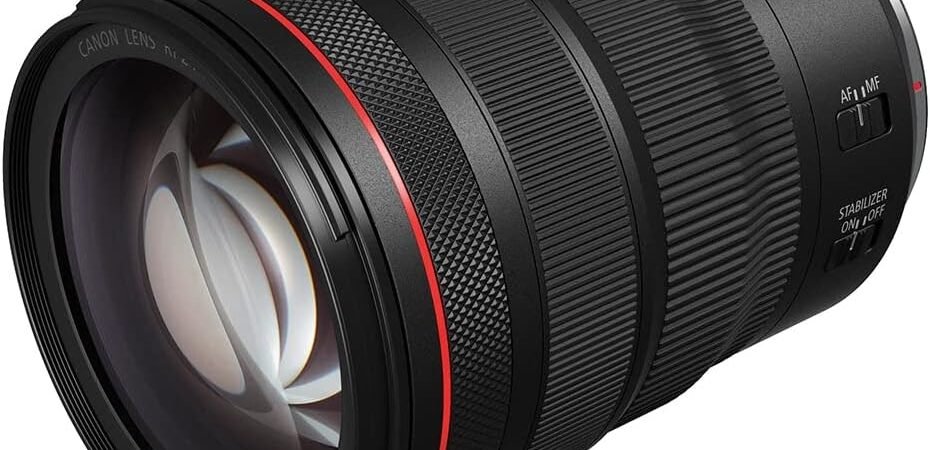
A camera lens can have a major influence on how easily photographers move between different types of scenes. Wide environmental photographs, portraits, travel images, events, and everyday subjects can sometimes require very different focal lengths. Carrying several lenses can solve that problem, but it also adds weight, changing lenses takes time, and every lens swap creates another opportunity for dust or moisture to reach the camera system.
The Canon RF24-70mm F2.8 L IS USM takes a different approach by covering a commonly used standard zoom range in one lens. Designed for Canon’s EOS R-series RF-mount system, it combines a 24–70mm focal-length range with a constant f/2.8 maximum aperture, optical image stabilization, and Canon’s L-series construction. Canon lists the lens at approximately 900 grams, with a 21-element, 15-group optical design.
The focal-length range is one of the main reasons this type of lens appears in many photography kits. At 24mm, photographers can work with a relatively broad field of view for landscapes, architecture, interiors, travel scenes, and environmental portraits. Moving toward 50mm provides a more natural perspective for many everyday subjects, while 70mm offers a tighter framing that can be useful for portraits and details.
This article explains the Canon RF24-70mm F2.8 L IS USM from an informational perspective, including its specifications, optical design, stabilization system, autofocus technology, practical applications, compatibility considerations, and differences between standard zoom categories.
Introduction to the Canon RF24-70mm F2.8 L IS USM
The Canon RF24-70mm F2.8 L IS USM is a standard zoom lens developed specifically around Canon’s RF mount. It belongs to Canon’s L-series, which is positioned within the company’s professional-oriented lens range.
Its central specification is the 24–70mm focal-length range combined with a constant f/2.8 maximum aperture. Unlike a variable-aperture zoom, the maximum aperture does not change as the lens moves from 24mm toward 70mm. That consistency can be useful when photographers change focal length while maintaining a particular exposure approach.
Canon also incorporates optical image stabilization into the lens. The company specifies up to five stops of shake correction under its stated CIPA testing conditions, using a compatible EOS R camera at 70mm. Actual stabilization performance can vary depending on the camera body, focal length, shooting conditions, and technique.
Autofocus is handled by Canon’s Nano USM technology. The manufacturer describes the system as providing high-speed, smooth, and quiet autofocus operation, while also designing the lens with reduced focus breathing for moving-image applications.
The lens also includes a customizable control ring. Depending on the camera configuration, the ring can be assigned to functions such as aperture, shutter speed, ISO, or exposure compensation.
Together, these features make the lens particularly interesting for photographers who want a single standard zoom that can cover a broad range of everyday shooting situations.
Key Features and Specifications
24–70mm Focal-Length Range
The 24–70mm range is commonly associated with general-purpose photography because it covers several useful perspectives without moving into the specialized territory of long telephoto lenses.
At 24mm, the lens provides a broad perspective that can help include more of a scene. This can be useful for:
- Landscapes
- Architecture
- Travel photography
- Interior photography
- Environmental portraits
- Group photographs
- Street photography
At approximately 35–50mm, the perspective becomes more moderate. These focal lengths can work well for everyday photography, documentary-style images, and subjects where a wider perspective is unnecessary.
At 70mm, the lens provides a tighter field of view. This can be useful for portraits, details, products, and isolating part of a larger scene.
The ability to move through this range without changing lenses is one of the primary practical advantages of a standard zoom.
Constant f/2.8 Maximum Aperture
The lens has a maximum aperture of f/2.8 throughout its zoom range.
A constant aperture has several practical implications. Photographers can change focal length without the lens automatically changing its maximum aperture from one end of the zoom to the other.
The f/2.8 aperture can also allow more light to reach the camera sensor than many slower standard zooms. This can be helpful in indoor environments, evening photography, events, and other situations where available light is limited.
A wider aperture also provides more control over depth of field. At suitable focusing distances, f/2.8 can help separate a subject from its surroundings, although the resulting background appearance depends on focal length, subject distance, background distance, sensor format, and other factors.
Optical Image Stabilization
Canon specifies up to five stops of optical image stabilization under its CIPA test conditions.
Image stabilization is designed to compensate for certain types of camera movement. It can be particularly useful when photographing relatively stationary subjects at slower shutter speeds.
Stabilization does not freeze a moving subject. If a person, animal, vehicle, or other subject is moving quickly, subject movement can still produce blur even when the lens is stabilizing the camera.
The lens can also communicate with compatible EOS R cameras, allowing camera and lens stabilization systems to work together on supported bodies. Canon refers to this as Combination IS.
Nano USM Autofocus
The RF24-70mm F2.8 L IS USM uses Nano USM autofocus technology. Canon designed the system for fast, precise, and quiet focusing, making it relevant to both still photography and video applications.
Quiet focusing can be especially useful for video because excessive mechanical or focusing noise can potentially become noticeable in recorded audio, depending on the camera setup and microphone placement.
Canon also highlights reduced focus breathing during focus transitions. Focus breathing refers to an apparent change in framing that can occur when the focus distance changes. Reducing this effect can make focus transitions look more consistent in video.
Optical Construction
Canon lists the lens as having 21 elements arranged in 15 groups. The design includes three aspherical elements and three UD elements.
Aspherical elements can help control certain optical aberrations and distortion characteristics. UD, or Ultra Low Dispersion, elements are used to help control chromatic aberration.
The lens also incorporates Canon’s Air Sphere Coating, which is intended to reduce flare and ghosting caused by unwanted reflected light.
These technologies are part of the overall optical design rather than features that should be considered independently. Image quality is influenced by the complete optical system, camera sensor, aperture, lighting, focusing conditions, and processing.
Nine-Blade Circular Aperture
The lens uses a nine-blade aperture diaphragm. Canon specifies the blades as circular.
The shape of the aperture can influence the appearance of out-of-focus highlights and background blur. This is particularly relevant when photographing subjects at relatively close distances with the aperture opened widely.
Minimum Focusing Distance
The minimum focusing distance varies with focal length. Canon specifies approximately 0.21 meters at the wide end and 0.38 meters at the telephoto end. Maximum magnification is approximately 0.3x at 32mm.
This gives the lens useful close-focusing capability for subjects such as food, tabletop objects, products, flowers, and smaller details.
It is important, however, to distinguish close focusing from true macro photography. A maximum magnification of 0.3x does not make this a dedicated 1:1 macro lens.
Control Ring
The control ring is one of the physical features associated with Canon’s RF lens system. It can be customized for several camera functions, including aperture, shutter speed, ISO, and exposure compensation.
This allows photographers to place a frequently used adjustment on the lens itself rather than relying entirely on camera controls.
For some users, this can make manual exposure adjustments more intuitive. The exact function and behavior depend on the compatible camera body’s settings.
Dust- and Weather-Resistant Construction
Canon describes the RF24-70mm F2.8 L IS USM as having dust- and weather-resistant construction, with sealing around the lens mount, switch panel, and rings.
This type of construction is useful for photographers who work outdoors, but weather resistance should not be interpreted as permission to expose the lens to unlimited amounts of rain, water, dust, sand, or extreme conditions.
The condition of the camera body, attached accessories, seals, and operating environment can all affect the overall protection of the system.
Fluorine Coating
Canon also uses fluorine coatings on the front and rear surfaces. The company states that these coatings help reduce the adhesion of dirt and make fingerprints and smudges easier to clean.
This does not eliminate the need for proper lens care. A front filter or lens cap can still provide useful protection during transportation and storage.
82mm Filter Size
The lens accepts filters with an 82mm diameter.
Photographers using filters should consider the cost and size of 82mm accessories when building a kit. Circular polarizers, neutral-density filters, and protective filters are among the types commonly used with compatible lenses, although the appropriate filter depends on the intended application.
How the Canon RF24-70mm F2.8 L IS USM Can Be Used
Travel Photography
Travel often involves unpredictable subjects and rapidly changing distances. One moment might involve a large architectural structure, followed by a street scene, food photograph, portrait, or detail.
A 24–70mm zoom can reduce the need to change lenses as frequently. The 24mm end can help with broader scenes, while 70mm offers tighter framing when the photographer cannot or does not want to move closer.
The lens’s 900-gram weight should nevertheless be considered when planning a lightweight travel kit.
Portrait Photography
The 70mm end can be useful for portraits, especially when a photographer wants a tighter composition without using a dedicated telephoto portrait lens.
The f/2.8 aperture can also provide relatively shallow depth of field when combined with appropriate subject and camera distances.
Portrait photographers should still consider whether they prefer the perspective and background rendering of a dedicated longer focal-length prime lens.
Events and Weddings
Events can present constantly changing compositions. A photographer may need a relatively wide view for a group and then a tighter frame for an individual without physically changing position.
The 24–70mm range is therefore well suited to many event-oriented situations.
The constant f/2.8 aperture can also be useful in indoor venues, although photographers should remember that exposure decisions depend on the camera body, lighting, subject movement, and desired shutter speed.
Landscape Photography
The 24mm focal length can provide a relatively broad view of landscapes.
It can also be useful for environmental scenes where the relationship between a subject and its surroundings is important.
At 70mm, the photographer can isolate distant details within a landscape instead of always photographing the entire scene.
This ability to change perspective without changing lenses can be valuable when working from a fixed viewpoint.
Street Photography
A standard zoom offers flexibility for street photography because the photographer can change framing as subjects move closer or farther away.
The 24–35mm portion can work well for environmental scenes, while 50–70mm can provide tighter compositions.
The suitability of the lens for street photography will depend partly on the photographer’s preferences, since a 900-gram lens may feel substantially different from a small prime lens during long walking sessions.
Food and Product Photography
The close-focusing capabilities can be useful for photographing food, tabletop objects, crafts, and products.
The approximately 0.3x maximum magnification can help fill more of the frame with a subject than a conventional lens with weaker close-focus performance.
For commercial product work requiring very high magnification or specialized perspective control, a dedicated macro or specialty lens may still be more appropriate.
Video Production
The lens can also be considered for video work. Canon specifically highlights its Nano USM focusing system and reduced focus breathing.
The constant aperture is also useful when changing focal length during a production because the maximum aperture remains f/2.8.
However, video users should consider lens weight, stabilization behavior, focus control, camera balance, and the potential for recorded operational sounds depending on the overall setup.
Who This Lens May Be Suitable For
Full-Frame EOS R Photographers
The lens was designed for Canon’s EOS R-series RF-mount system. Compatibility should always be confirmed against the exact camera body before purchasing or mounting any lens. Canon identifies the RF24-70mm F2.8 L IS USM as an RF lens for EOS R-series cameras.
For photographers using a compatible full-frame EOS R body, the 24–70mm range can serve as a general-purpose focal-length range.
Event Photographers
Event photographers often need flexibility because subjects and distances change quickly. A standard zoom can reduce the number of lens changes required throughout a session.
The f/2.8 aperture and stabilization system are also relevant considerations for indoor environments.
Travel Photographers Who Prefer Flexibility
Travel photographers who value a single versatile lens may appreciate the ability to move between wide and moderate telephoto framing.
On the other hand, travelers prioritizing the smallest possible kit may find the approximately 900-gram weight significant.
Hybrid Photo and Video Creators
The combination of constant f/2.8 aperture, Nano USM autofocus, stabilization, control-ring functionality, and reduced focus breathing makes the lens relevant to creators who work across both photography and video.
Important Things to Consider
Camera Compatibility
The first consideration is the camera mount.
This lens uses Canon’s RF mount. It should not be confused with Canon EF lenses, which use a different mount system.
Photographers should confirm that their camera accepts RF lenses before considering this lens for their system.
Weight and Size
The lens weighs approximately 900 grams and has a maximum diameter of approximately 88.5mm. Canon lists its minimum overall length at approximately 125.7mm.
Those dimensions are reasonable to evaluate alongside the camera body, because the combination determines how portable the complete kit will feel.
A photographer accustomed to compact prime lenses may experience the RF24-70mm F2.8 L IS USM very differently from someone already using larger professional zoom lenses.
The 24mm Wide End Is Not Ultra-Wide
Although 24mm is wide compared with normal and telephoto focal lengths, it is not equivalent to a dedicated ultra-wide lens.
Photographers working with very large interiors, dramatic foreground perspectives, architecture, or expansive landscapes may still want a wider lens available.
The 70mm End Is Not a Long Telephoto
Likewise, 70mm is useful for tighter framing but does not replace a dedicated telephoto lens.
Wildlife, distant sports, bird photography, and other subjects requiring substantial reach generally call for longer focal lengths.
Constant f/2.8 Does Not Guarantee Low-Light Results
The f/2.8 aperture is useful, but exposure is determined by multiple factors.
A subject moving quickly indoors may still require a fast shutter speed. Stabilization can help with camera movement, but it cannot prevent blur caused by subject movement.
Image Stabilization Has Limits
Canon’s five-stop figure is based on standardized testing under specified conditions.
Real-world results can vary.
Stabilization is most directly helpful for reducing camera movement. It should not be interpreted as a guarantee that handheld images will always be sharp at a particular shutter speed.
Filters and Accessories
The 82mm filter diameter is another practical consideration. Photographers who already own filters in other sizes may need an appropriate solution.
The lens is supplied with a lens hood, front and rear caps, and a lens case according to Canon’s listed contents.
Maintenance
Although the lens includes protective coatings and weather-resistant construction, careful maintenance remains important.
A practical maintenance routine can include:
- Keeping the front and rear caps attached when the lens is not in use
- Storing the lens in a dry, protected environment
- Using suitable lens-cleaning materials
- Avoiding unnecessary contact with optical surfaces
- Inspecting the mount and exterior for dust or debris
- Keeping the lens hood available for outdoor photography
For significant contamination, impact damage, moisture intrusion, or mechanical problems, professional service may be appropriate.
Comparing General Lens Categories
Understanding how this lens differs from other broad categories can help put its design into context.
Standard Zoom vs. Prime Lens
A prime lens has one fixed focal length, while a standard zoom provides multiple focal lengths in one lens.
A prime may offer a wider maximum aperture, smaller physical dimensions, or a different rendering style depending on the specific model.
The standard zoom’s advantage is flexibility. Instead of carrying separate lenses for several focal lengths, one lens can cover 24, 35, 50, and 70mm positions.
Standard Zoom vs. Slower Kit Zoom
Many general-purpose zoom lenses use variable maximum apertures that become smaller as the lens is zoomed toward the telephoto end.
The RF24-70mm F2.8 L IS USM maintains f/2.8 across its entire zoom range.
That can make the lens more consistent for exposure and depth-of-field control, particularly when moving between focal lengths.
A slower kit zoom may nevertheless be smaller and lighter, making it potentially more suitable for photographers who prioritize portability.
Standard Zoom vs. Ultra-Wide Zoom
An ultra-wide zoom is designed to provide a substantially wider field of view.
The RF24-70mm begins at 24mm, making it a more general-purpose lens rather than an ultra-wide specialist.
A photographer working with architecture or very confined spaces may prefer having an ultra-wide lens alongside a standard zoom.
Standard Zoom vs. Telephoto Zoom
A telephoto zoom extends substantially beyond 70mm.
Such lenses are more appropriate when the subject is far away or when a compressed perspective is desired.
The 24–70mm lens instead emphasizes everyday and moderately wide-to-short-telephoto perspectives.
Standard Zoom vs. Macro Lens
The RF24-70mm can focus relatively close and offers approximately 0.3x maximum magnification at 32mm.
A dedicated macro lens is designed around substantially greater magnification and close-subject work.
For everyday close-ups, the Canon’s focusing capability can be useful. For specialized macro photography, a dedicated macro lens remains a different category.
Optical Design and Image Quality Considerations
Lens specifications are useful, but they do not describe every aspect of an image.
The RF24-70mm F2.8 L IS USM combines multiple optical technologies, including aspherical elements, UD elements, Air Sphere Coating, and a nine-blade aperture.
The aspherical elements help address certain forms of optical aberration and distortion, while UD elements help control chromatic aberration.
Air Sphere Coating is designed to reduce flare and ghosting, which can be particularly relevant when strong light sources appear in or near the frame.
Actual photographs will still depend on lighting, aperture, focal length, subject distance, camera sensor, autofocus behavior, and post-processing.
For that reason, specifications should be understood as indicators of the lens’s design rather than guarantees of a particular visual result in every situation.
Understanding the Lens’s 24–70mm Range
One useful way to understand the lens is to divide the focal range into three broad sections.
24–35mm
This portion is useful for scenes where the surroundings are an important part of the composition.
Potential applications include:
- Landscapes
- Architecture
- Travel scenes
- Environmental portraits
- Groups
- Interiors
35–50mm
The middle portion offers a more moderate perspective.
It can work for:
- Everyday photography
- Street scenes
- Documentary images
- Food photography
- Environmental portraits
- General-purpose shooting
50–70mm
The longer end is useful when tighter framing is desired.
Potential applications include:
- Portraits
- Details
- Products
- Food
- Head-and-shoulder compositions
- Isolating subjects from a larger scene
The important point is not that each focal length has only one purpose. Creative photographers can use the same focal length in many different ways depending on their position, composition, and subject.
Frequently Asked Questions
Is the Canon RF24-70mm F2.8 L IS USM a full-frame lens?
It is an RF-mount lens designed for Canon’s EOS R-series system. Canon describes it as an RF lens for the EOS R system.
Always check the specifications of the particular camera body before purchasing.
What is the maximum aperture?
The maximum aperture is f/2.8 throughout the 24–70mm zoom range.
Does the lens have image stabilization?
Yes. Canon specifies optical image stabilization with up to five stops of correction under its stated testing conditions.
What autofocus system does it use?
The lens uses Canon’s Nano USM autofocus system. Canon describes it as providing fast, smooth, and quiet autofocus operation.
How close can the lens focus?
Canon lists a minimum focusing distance of approximately 0.21 meters at the wide end and 0.38 meters at the telephoto end. Maximum magnification is approximately 0.3x at 32mm.
Is it suitable for portraits?
The 50–70mm portion of the range can be useful for portrait compositions. The constant f/2.8 aperture also provides control over depth of field.
Whether it is suitable for a particular portrait style depends on the photographer’s preferred focal length, working distance, and desired background appearance.
Can it be used for video?
Yes, it can be used for video on compatible RF-mount cameras. Canon highlights its Nano USM focusing system and reduced focus breathing for moving-image applications.
Does it have a customizable control ring?
Yes. Canon states that the control ring can be assigned to functions such as aperture, shutter speed, ISO, and exposure compensation.
What filter size does it use?
The lens uses an 82mm filter diameter.
How much does the lens weigh?
Canon lists the weight at approximately 900 grams, or about 1.98 pounds.
Is the lens weather resistant?
Canon describes the lens as having dust- and weather-resistant construction, including sealing around the mount, switch panel, and rings.
This should not be interpreted as making the lens completely waterproof. Appropriate care is still important in wet or dusty environments.
Is this a macro lens?
No. It has useful close-focusing capability and approximately 0.3x maximum magnification, but it is not a dedicated 1:1 macro lens.
Can it replace every other lens?
No lens can cover every photographic situation.
The 24–70mm range can handle many common subjects, but photographers may still want ultra-wide lenses for expansive scenes, telephoto lenses for distant subjects, or macro lenses for high-magnification work.
Conclusion
The Canon RF24-70mm F2.8 L IS USM is built around a practical concept: combine a widely useful standard zoom range with a constant f/2.8 aperture, optical stabilization, modern autofocus, and a professional-oriented physical design.
Its 24–70mm range spans broad environmental compositions through moderate telephoto framing, while the constant f/2.8 aperture provides consistent maximum-aperture behavior throughout the zoom range. Canon also incorporates Nano USM autofocus, optical image stabilization rated up to five stops under specified conditions, a customizable control ring, a 21-element optical construction, and dust- and weather-resistant construction.
At the same time, its approximately 900-gram weight, 82mm filter size, RF-mount compatibility, and standard-zoom limitations are worth considering before adding it to a camera system.
For photographers using compatible Canon EOS R equipment, understanding these characteristics can make it easier to determine whether the lens’s focal range, aperture, stabilization, focusing system, and physical design fit their particular style of photography.