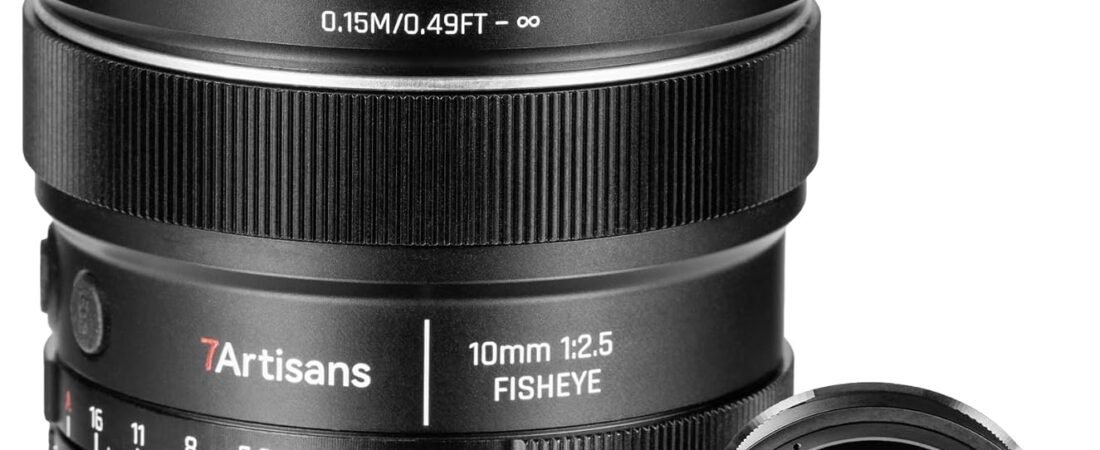
Ultra-wide lenses can change the way a camera captures space. Instead of simply fitting more of a scene into the frame, an extremely wide focal length can emphasize foreground subjects, stretch the visual relationship between objects, and create a distinctive sense of perspective. Fisheye lenses take that idea even further by embracing strong barrel-shaped distortion as part of the image’s visual character.
The 7artisans AF 10mm F2.5 Autofocus Fisheye Lens is designed around this concept. With a 10mm focal length, an f/2.5 maximum aperture, autofocus, and an approximately 185-degree field of view, it belongs to a specialized category of ultra-wide fisheye lenses. The version discussed here is designed for cameras using the L-Mount system.
Rather than approaching a fisheye lens like a conventional rectilinear wide-angle lens, it is useful to understand what makes this category different. A standard wide-angle lens generally attempts to keep straight lines relatively straight, although some distortion can still occur. A fisheye lens deliberately produces a much stronger curved perspective. This can create circular or highly expansive compositions that are difficult to reproduce with ordinary wide-angle lenses.
That makes a lens such as the 7artisans AF 10mm F2.5 particularly relevant to photographers interested in creative landscapes, architecture, interiors, action-oriented compositions, astrophotography, video projects, and experimental photography.
This article explores the lens from an informational perspective, covering its main characteristics, practical applications, autofocus system, ultra-wide perspective, optical considerations, compatibility, limitations, and how fisheye lenses compare with other wide-angle categories.
Introduction to the 7artisans AF 10mm F2.5 Fisheye Lens
The central feature of this lens is its combination of an extremely short 10mm focal length and fisheye optical design.
At such a short focal length, the lens can capture a very large portion of the surrounding environment. The approximately 185-degree field of view means that the lens is designed to record an exceptionally broad perspective.
Unlike a conventional 10mm rectilinear lens, however, a fisheye design does not attempt to maintain the same geometric rendering of straight lines across the frame. Instead, lines away from the center can curve noticeably.
That characteristic is not necessarily a flaw. In fisheye photography, the distortion is part of the creative purpose of the lens.
The f/2.5 maximum aperture is another important characteristic. A relatively wide aperture can allow more light to reach the camera sensor, which can be useful for night scenes, indoor photography, and other situations where available light is limited.
The autofocus system also distinguishes this lens from many fully manual ultra-wide or fisheye lenses. Autofocus can make it easier to work with moving subjects and fast-changing compositions, while manual focusing remains relevant for photographers who prefer deliberate control.
Because this particular model is designed for L-Mount, compatibility is an important consideration. Photographers should verify that their camera body uses the appropriate L-Mount interface before purchasing or attempting to mount the lens.
Key Features
10mm Ultra-Wide Focal Length
The 10mm focal length places this lens firmly into the ultra-wide category.
A short focal length allows the camera to capture a very broad area of the scene. Objects close to the front of the lens can appear particularly large relative to objects farther away.
This creates opportunities for dramatic compositions.
For example, a photographer standing close to a foreground object can make that subject visually dominant while still including a large amount of background information.
At the same time, the extremely wide perspective requires careful composition. Small changes in camera position can have a noticeable effect on the relationship between foreground and background elements.
Approximately 185-Degree Field of View
The approximately 185-degree field of view is one of the most distinctive specifications associated with this lens.
A field of view approaching 180 degrees means the lens captures an enormous amount of the surrounding environment.
That can be useful for:
- Creative landscape photography
- Interior spaces
- Architectural experiments
- Action-oriented compositions
- Large environmental scenes
- Astrophotography
- Experimental video
- Creative self-portrait photography
The exact appearance of the captured scene depends on the camera sensor, shooting position, orientation, and composition.
Because such a broad field of view can include objects that are normally outside a photographer’s attention, photographers need to pay attention to the edges and corners of the frame.
Fisheye Optical Design
The fisheye design is perhaps the most important distinction between this lens and an ordinary ultra-wide-angle lens.
A rectilinear wide-angle lens attempts to preserve straight lines, particularly toward the center of the image. A fisheye lens instead uses a projection that allows a much wider field of view while accepting substantial curvature.
As a result, architectural lines, horizons, walls, and other straight structures can bend significantly.
This can produce highly recognizable fisheye imagery.
The effect becomes especially noticeable when the camera is pointed toward structures containing strong horizontal or vertical lines.
Photographers can either embrace this distortion as a creative element or compose carefully to control how prominent it becomes.
f/2.5 Maximum Aperture
The lens has a maximum aperture of f/2.5.
A wider aperture allows more light to reach the camera sensor compared with smaller apertures.
This can be relevant when photographing:
- Night landscapes
- Stars and the night sky
- Indoor scenes
- Events
- Creative low-light compositions
- Moving subjects in available light
Aperture also influences depth of field. At such a short focal length, however, depth-of-field behavior can differ considerably from that of longer lenses.
The actual background separation achieved at f/2.5 depends on focusing distance, subject distance, camera format, and composition.
Autofocus
The “AF” designation indicates that the lens includes autofocus functionality.
Autofocus can be useful when subjects are changing position or when the photographer wants the camera to handle focusing rather than manually adjusting the focus ring.
This can be particularly convenient for casual photography, video work, street scenes, and situations where the photographer needs to react quickly.
Autofocus behavior can vary according to the camera body, firmware, shooting mode, subject characteristics, and lighting conditions. As with any third-party autofocus lens, users should verify compatibility and supported functions with their specific L-Mount camera.
L-Mount Compatibility
This version of the lens is designed for L-Mount cameras.
The L-Mount system is used by multiple camera manufacturers, making it important to identify the exact camera body rather than assuming every L-Mount feature behaves identically across different manufacturers.
Electronic communication between the camera and lens can vary by model and firmware.
Before purchasing, users should check the manufacturer’s compatibility information for their particular camera.
How the 7artisans AF 10mm F2.5 Can Be Used
Creative Landscape Photography
Traditional landscape photography often emphasizes natural perspective, but an ultra-wide fisheye lens can create something much more dramatic.
A close foreground rock, plant, pathway, or other object can become visually dominant while the lens captures a huge portion of the surrounding environment.
This can make the scene feel unusually expansive.
Fisheye distortion can also turn a relatively ordinary horizon into a curved visual element, depending on camera orientation and the composition.
The technique works particularly well when the foreground contains strong shapes or textures.
Astrophotography
The combination of an ultra-wide field of view and an f/2.5 aperture makes this type of lens relevant to certain astrophotography applications.
A very broad field of view can allow photographers to include substantial portions of the night sky while also incorporating foreground elements such as mountains, buildings, trees, or landscapes.
The wide perspective can also make it easier to compose scenes containing large portions of the Milky Way or star-filled skies.
Astrophotography performance depends on considerably more than aperture and focal length, however. Sensor characteristics, atmospheric conditions, light pollution, focus accuracy, exposure settings, and post-processing all influence the final result.
Interior Photography
A fisheye lens can capture a large amount of an interior from a relatively limited shooting position.
This can be useful for creative interior photography, documentation, and certain virtual-tour applications.
However, strong fisheye distortion can make walls, doors, furniture, and architectural lines appear curved.
For professional architectural documentation where geometric accuracy is important, a rectilinear ultra-wide lens may be more appropriate.
The fisheye format is generally more suitable when the visual effect itself is desirable.
Architecture
Architecture provides many opportunities for fisheye compositions.
Curved lines can create unusual interpretations of buildings, bridges, tunnels, domes, staircases, and other structures.
Photographers can experiment with placing a central architectural feature near the middle of the frame while allowing surrounding lines to curve outward.
The result can be very different from what a conventional wide-angle lens produces.
Action and Sports Photography
Ultra-wide fisheye lenses can be used for certain action-oriented photography where the camera is positioned relatively close to the subject.
The extremely wide perspective allows the photographer to include the surrounding environment while keeping a nearby subject prominent.
This can produce a strong sense of movement and scale.
For safety reasons, the camera should always be positioned appropriately for the activity, with enough distance and protection from moving equipment, vehicles, athletes, or other hazards.
Skateboarding and Outdoor Action
Creative action photography is another area where fisheye lenses have historically been popular.
A close camera position can exaggerate the relationship between the subject and surroundings. A skateboarder, cyclist, or other athlete can appear large in the foreground while the environment spreads dramatically around them.
The lens’s autofocus capability can also be useful when the subject’s distance changes quickly.
The appropriate setup depends on the camera and activity, and photographers should prioritize safe camera placement over getting extremely close to the subject.
Creative Video
Fisheye lenses can produce distinctive video perspectives.
The very broad field of view can be useful for:
- Action videos
- Creative travel footage
- Music and artistic projects
- Indoor scenes
- Experimental filmmaking
- Immersive-looking compositions
The curved geometry creates an immediately recognizable aesthetic.
However, the same distortion can make conventional dialogue scenes or architectural footage look unusual, so whether it works depends heavily on the creative objective.
Self-Portraits and Group Scenes
The extremely wide perspective can help include several people in a relatively small space.
It can also be used creatively for self-portraits.
Subjects placed close to the lens can appear disproportionately large, which can create humorous or stylized results.
Care is necessary when people are positioned near the edges because facial and body proportions can appear significantly altered.
Understanding Fisheye Distortion
One of the most important things to understand before using a lens like this is the difference between fisheye distortion and ordinary wide-angle distortion.
With a conventional wide-angle lens, photographers may notice perspective distortion when photographing objects from close distances. Lines can appear stretched toward the edges, particularly with very short focal lengths.
A fisheye lens takes a fundamentally different approach.
Its projection allows an extremely large field of view while permitting straight lines away from the center to curve.
This produces the characteristic fisheye appearance.
The amount of visible curvature depends on the subject, camera orientation, position, and where objects appear in the frame.
A horizon positioned near the center may behave differently from one positioned toward the edge.
This gives photographers considerable creative control simply through composition.
Who the Lens May Be Suitable For
Creative Photographers
Photographers looking for a distinctive visual perspective may find fisheye lenses interesting because they produce an appearance that is difficult to replicate with conventional lenses.
The lens can be particularly relevant to experimental photography and projects where visual interpretation is more important than geometric accuracy.
Landscape Photographers
Landscape photographers who enjoy exaggerated foreground perspectives and extremely broad environmental scenes may find the 10mm focal length useful.
It is especially interesting for compositions where the photographer can place a subject close to the camera.
Astrophotography Enthusiasts
The combination of ultra-wide coverage and an f/2.5 aperture makes the lens relevant to photographers exploring night-sky compositions.
The wide perspective can make it easier to include large portions of the sky and foreground.
Video Creators
Creators working with action footage, artistic video, travel content, and experimental perspectives may find a fisheye lens useful as a specialized addition to a broader lens kit.
L-Mount Camera Owners
The lens is specifically intended for L-Mount systems, making it most relevant to photographers who already use compatible cameras.
Camera-specific compatibility should always be confirmed before purchase.
Important Things to Consider
Fisheye Is a Specialized Look
A fisheye lens is not simply a wider replacement for every conventional lens.
The strong curvature is a defining characteristic.
Photographers who primarily photograph architecture, interiors, real estate, or products may prefer a rectilinear ultra-wide lens when maintaining straight lines is important.
Extremely Wide Lenses Require Composition Awareness
At 10mm, the lens captures an enormous portion of the surrounding scene.
This means unwanted objects can easily appear at the edge of the frame.
Photographers may notice:
- Their feet
- Tripod legs
- Camera straps
- Nearby lights
- Equipment
- People standing beside the camera
The wider the field of view, the more carefully the entire frame needs to be checked.
Foreground Objects Can Become Very Large
Objects positioned close to the lens can appear dramatically larger than expected.
This can be used creatively, but it can also make portraits or everyday compositions look unusual.
Understanding the relationship between camera distance and subject placement is therefore particularly important.
Compatibility Should Be Verified
Although the lens is designed for L-Mount, users should confirm compatibility with the exact camera model.
Autofocus performance, electronic communication, stabilization behavior, and firmware support can vary between camera systems.
Fisheye vs. Rectilinear Wide Angle
This distinction is worth emphasizing.
A rectilinear ultra-wide lens is generally intended to keep straight lines visually straight, although some correction may still be necessary.
A fisheye lens intentionally uses a different projection.
Neither category is universally appropriate. They simply serve different creative and technical purposes.
Low-Light Photography Still Requires Appropriate Exposure
The f/2.5 aperture can help gather light, but it does not eliminate the need for appropriate exposure decisions.
In low light, image quality can still be affected by shutter speed, ISO, subject movement, camera stability, and the characteristics of the camera sensor.
For astrophotography, focusing and environmental conditions are additional considerations.
Front-Element Protection
Ultra-wide fisheye lenses can have highly exposed front optical elements because of their unusually broad field of view.
Photographers should handle the front of the lens carefully and follow the manufacturer’s recommendations for cleaning.
A standard screw-in filter may not always be practical with fisheye designs, particularly when the front element is strongly curved or extends close to the edge of the lens.
Users should verify which accessories are specifically compatible with this lens.
Comparing General Lens Categories
Fisheye vs. Rectilinear Ultra-Wide
Both categories provide very broad fields of view, but their visual rendering is different.
A fisheye lens emphasizes curved geometry and can produce an intentionally distorted appearance.
A rectilinear ultra-wide lens generally aims to preserve straight lines, making it more suitable for architectural and interior applications where geometry matters.
The choice depends largely on the desired result.
Fisheye vs. Standard Wide-Angle
A standard wide-angle lens provides a broader perspective than normal lenses but generally remains more natural-looking.
A 10mm fisheye goes considerably further in terms of field of view and visual distortion.
Standard wide-angle lenses are often more flexible for everyday photography, while fisheye lenses tend to be more specialized.
Fisheye vs. Standard Zoom
A standard zoom can cover multiple focal lengths and may be more appropriate when flexibility is the primary goal.
A 10mm fisheye, by comparison, provides a very specific visual effect and field of view.
Photographers who already own a standard zoom may therefore view a fisheye as a complementary specialty lens rather than a replacement.
Fisheye vs. Prime Wide-Angle Lens
A conventional wide-angle prime typically emphasizes a single focal length while maintaining a more familiar perspective.
The 7artisans 10mm fisheye is also a fixed focal-length lens, but its projection is specifically designed around an extremely broad field of view.
This makes the two categories useful for different kinds of photography.
Working With the 10mm Perspective
At 10mm, camera position becomes an especially important creative tool.
Moving closer to a foreground object can make it dominate the composition.
Moving backward reduces its relative size while retaining the extremely broad field of view.
Changing the camera’s vertical orientation can also affect how buildings, horizons, and other lines curve.
This makes fisheye photography less about simply choosing a focal length and more about controlling the relationship between camera position, subject placement, and frame geometry.
For photographers new to fisheye lenses, experimentation can be useful. Taking several compositions from slightly different positions can reveal how dramatically perspective changes at such a short focal length.
Fisheye Photography for Architecture and Interiors
Architecture is one of the clearest examples of why understanding the lens category matters.
A conventional ultra-wide lens might be selected when the photographer needs to show a large room while preserving relatively straight walls.
A fisheye lens instead provides an opportunity to interpret the room in a more artistic way.
Domed ceilings, curved staircases, tunnels, bridges, and circular structures can become especially interesting because the fisheye projection reinforces their geometry.
For property documentation or technical architectural work, however, photographers should consider whether distortion correction or a rectilinear lens would better match the intended result.
Fisheye Photography for the Night Sky
A very wide lens can be useful for night landscapes because it can include a large portion of the sky.
The 10mm focal length also provides opportunities to combine stars with strong foreground elements.
The f/2.5 aperture allows a relatively substantial amount of light to reach the sensor, although the actual suitability for astrophotography depends on the complete camera system and environmental conditions.
Night photography also requires attention to:
- Light pollution
- Clouds
- Atmospheric conditions
- Focus
- Camera stability
- Exposure
- Battery life
- Dew and condensation
A lens alone cannot determine the quality of a night-sky photograph.
Autofocus and Video Considerations
Autofocus is particularly interesting on an ultra-wide lens because many subjects can appear relatively deep within the scene.
For still photography, autofocus can make everyday use more convenient.
For video, smooth focusing behavior can matter even more because abrupt focus changes may become visually distracting.
The actual autofocus experience will depend on the connected L-Mount camera body, its autofocus system, firmware, subject recognition capabilities, and shooting mode.
Manual focus can still have a place in video and landscape photography where the photographer wants to maintain a predetermined focus distance.
Maintaining an Ultra-Wide Fisheye Lens
Proper maintenance helps preserve optical performance and physical condition.
Basic care can include keeping both lens caps attached when the lens is stored, avoiding unnecessary contact with the glass, and using appropriate optical cleaning materials.
Photographers should avoid aggressive cleaning methods or household cleaning products on lens elements.
If the lens is exposed to moisture, dust, or sand, it is sensible to follow the manufacturer’s recommended cleaning and storage procedures.
Because fisheye lenses can have unusual front-element shapes, compatible accessories should be selected carefully.
Frequently Asked Questions
What type of lens is the 7artisans AF 10mm F2.5?
It is an ultra-wide fisheye lens with a 10mm focal length and f/2.5 maximum aperture. The model discussed here is designed for L-Mount cameras.
What does 185 degrees mean?
The approximately 185-degree specification describes the extremely broad field of view. It means the lens can capture a very large portion of the surrounding environment.
Does the lens have autofocus?
Yes. The “AF” designation indicates autofocus functionality.
Actual autofocus performance depends on the compatible camera body, firmware, lighting, and subject.
Is the lens suitable for landscapes?
It can be used for creative landscape photography, particularly when an extremely broad perspective and pronounced fisheye rendering are desired.
Can it be used for astrophotography?
The 10mm focal length and f/2.5 aperture can make it relevant to night-sky photography. Results depend on the camera, environmental conditions, exposure, focusing, and post-processing.
Is it suitable for architecture?
It can produce highly creative architectural photographs, but its fisheye projection causes strong curvature. A rectilinear ultra-wide lens may be more appropriate when preserving straight architectural lines is important.
Is this a normal wide-angle lens?
No. It belongs to the fisheye category. Its extremely wide field of view and curved rendering distinguish it from conventional wide-angle lenses.
What cameras can use it?
This version is designed for the L-Mount system. Users should verify compatibility with their exact camera model before purchasing.
Can it be used for video?
Yes, an autofocus fisheye lens can be used for video on compatible cameras. Its extremely wide perspective can be particularly interesting for action, travel, and creative footage.
Will straight lines appear curved?
With a fisheye design, strong curvature is expected, particularly toward the edges of the frame.
The degree of visible curvature depends on composition and the position of the line within the frame.
Is it suitable for portraits?
It can be used creatively for portraits, especially when exaggerated perspective is intentional.
However, placing a person’s face very close to the edge of an extremely wide fisheye frame can produce unusual proportions.
Can it replace a standard zoom?
Generally, it serves a different purpose.
A standard zoom provides multiple conventional perspectives, while a fisheye lens provides an extremely wide and distinctive projection.
Many photographers would treat the two categories as complementary rather than interchangeable.
Conclusion
The 7artisans AF 10mm F2.5 Autofocus Fisheye Lens for L-Mount is built around a specialized photographic concept: an extremely wide field of view combined with the distinctive geometry of a fisheye optical design.
Its 10mm focal length and approximately 185-degree perspective can capture a remarkably large portion of a scene, while the f/2.5 aperture provides useful light-gathering capability for applications ranging from creative landscapes to night photography. Autofocus adds convenience for photographers and creators who work with changing subjects or video.
The most important consideration is understanding what a fisheye lens is designed to do. It is not simply a conventional wide-angle lens with a shorter focal length. Curved lines, exaggerated foreground perspective, and unusual spatial relationships are fundamental parts of its visual character.
For creative landscape work, astrophotography, interiors, action photography, experimental video, and other projects where an expansive and unconventional perspective is useful, this type of lens can provide possibilities that are difficult to achieve with ordinary lenses.
At the same time, photographers should consider L-Mount compatibility, the specialized nature of fisheye projection, composition requirements, front-element protection, and the difference between fisheye and rectilinear ultra-wide lenses before adding it to a camera system.
Understanding those characteristics makes it easier to decide how a 10mm fisheye could fit into an existing photography setup and which types of projects would benefit from its distinctive perspective.